
Palo Alto Arrest Log Reality
The sheriff's news page carries announcements, but no booking table. There is no date-filtered archive either. No current jail roster appears on it. Mugshot galleries are absent too. Neither the sheriff site nor the city sites offer an official arrest log for Palo Alto County. There is no 72-hour or seven-day version. The county jail still anchors every booking. Sheriff staff process every Palo Alto County arrest there. That role does not make the jail's web page a blotter.
Reading a log well means separating dates. The arrest date, booking date, and release date can each differ. So can the publication date of a news story and a later court date. An entry may also cover a citation with no jail admission. It may cover an initial appearance after booking. It may also note a juvenile referral with identifying details withheld. Match the source label to the event verb.
Read Palo Alto Police Reports
The best published blotter pattern here is newspaper coverage. The Reporter-Democrat, also known through Emmetsburg News, prints recurring police reports. Archived issues from August 2024, April 2024, and March 2023 show the pattern. Entries split adults booked into the Palo Alto County Jail from others. Some were merely cited or released. Initial appearances get separate mention. So do juvenile referrals. That mix is richer than an inmate list. Yet it remains selective reporting rather than a complete agency database.
- Start with a date range that includes the event and several later publication days.
- Identify whether the item says arrested, booked, cited, released, transferred, or referred.
- Note the named arresting agency and whether Palo Alto County Jail is actually stated.
- Compare the charge with Iowa Courts Online for a filed case and later disposition.
- Request the agency or jail record when the report lacks dates, custody status, or a clear identity match.
Only the newest bookings matter to some readers. The 24 Hour Arrests page handles that. An arrest log instead works backward across several days and published issues.
Palo Alto Arrest-Log Fields
Newspaper wording and official jail-calendar fields overlap. They are not the same record, though. The inventory here shows how to read a candidate log entry. Fill in no field the item itself does not state, and keep the exact source wording when a person was cited rather than booked or when bond changed after a hearing.
| Entry element | How to interpret it |
|---|---|
| Name | A reported identity that still needs spelling and same-name checks. |
| Event date | The reported arrest, citation, booking, or release date, not necessarily publication day. |
| Agency | The police, sheriff, state, or other authority connected to the event. |
| Custody wording | Whether the source expressly says booked, held, released, cited, or transferred. |
| Alleged charge | The charge as reported at that stage; later court wording may differ. |
| Bond or initial appearance | A release condition or early court step, never a conviction. |
| Photo | No official county arrest-log photo field or retention policy was verified. |
The KLGA Palo Alto County Sheriff's Office tag shows dated, article-driven regional coverage.
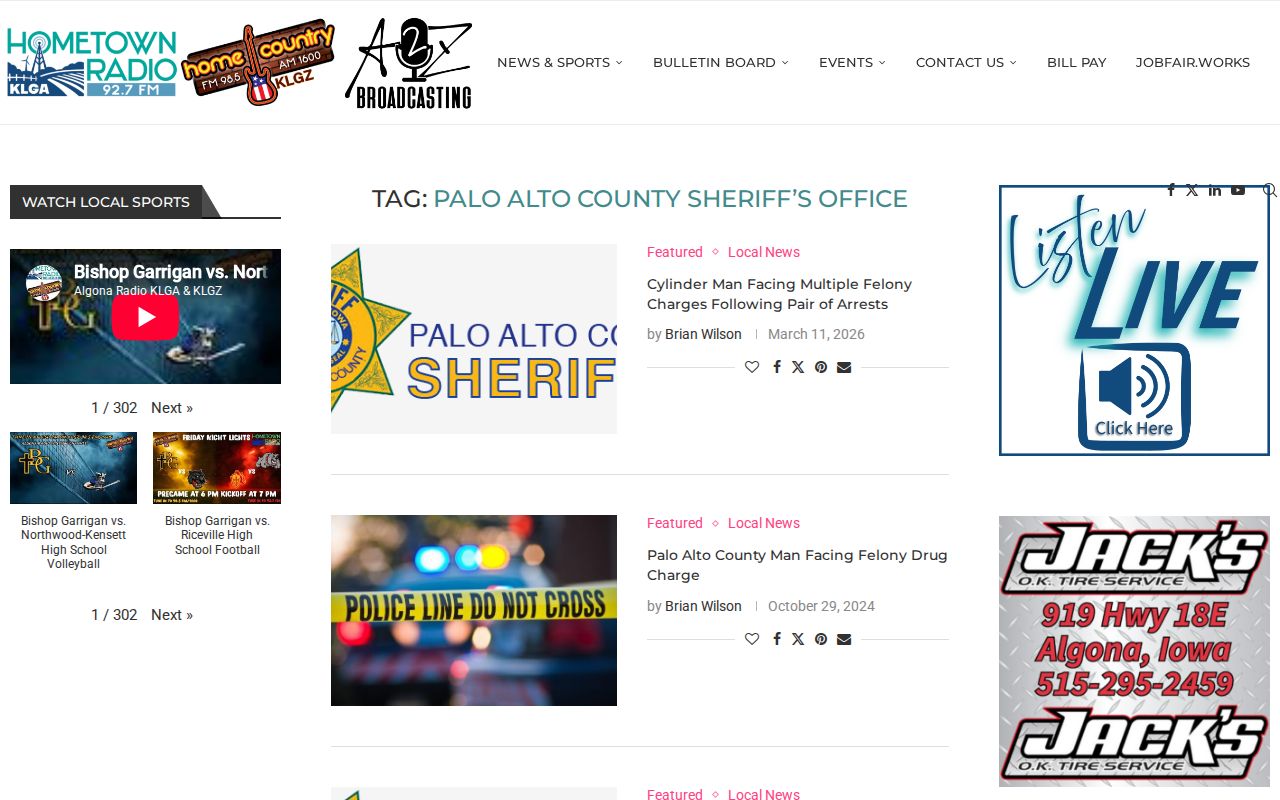
The story sample shows cadence and county coverage. It is not a booking roster.
Note: A story photograph is not automatically a booking photograph unless the publisher or originating agency identifies it as one.
Weekend Palo Alto Arrest Reports
One weekend arrest can surface four ways. A Friday-night arrest, a Saturday booking, a Monday court filing, and a later weekly story may all describe the same event. Weekends and holidays stretch the gaps. Agencies, courts, and newsrooms each follow their own work cycles, so the pieces rarely line up. The Reporter-Democrat runs weekly. Weekend events do not land on one set day, and the county has no fixed batch-posting hour.
Check the incident day first. Then look at the next business days and the following issue. Then compare verbs. "Arrested and booked" points to a jail event; "cited and released" may not, and an initial appearance is a court proceeding rather than the arrest itself. A juvenile referral should never be expanded with names or facts the source withheld.
Local Palo Alto Blotter Sources
Start with official sources. Contact the Palo Alto County Sheriff's Office or the city agency named in a report, then check the court docket. The Reporter-Democrat Police Reports category offers a secondary publication path. Access to it can be uneven. A blocked page says nothing about whether an arrest happened. It also does not turn the category into an official record.
Regional outlets publish sheriff releases too. KLGA's tag mixes county and city cases. Northwest Iowa Now carried a story on two arrests made on warrants. More 104.9 ran incident-level stories as well. These help locate a public statement. None promises daily, same-day, or complete coverage. For custody, return to the jail; for the legal outcome, use Iowa Courts Online.
Palo Alto Arrest Archives
Newspapers capture only part of the story. The Palo Alto County Digital Newspaper Archive searches several titles. Among them are the West Bend Journal, The Reporter, the Ruthven Zipcode, and The Democrat. Some runs reach far back. An archive tells you what a paper printed on a given day. It cannot tell you who sits in the Palo Alto County jail right now. An old arrest story may lack follow-up. The story may not say how the case ended.
For a current answer, go to the office that created the record. Ask the jail for its calendar. Ask also for a booking record, an incident report, or a release record. Iowa administrative jail rules set retention periods for several record types. Even so, they fix no booking-photo schedule for Palo Alto County. The State Historical Society records manual notes that schedules differ by record series. A state schedule does not automatically bind the county sheriff.
Search by name, place, agency, or date. Then save the title, issue date, and page number of anything useful. For a result that carries legal weight, cross-check it through Iowa Courts Online. The county clerk can also help. The official county court page lists that contact for the handoff. The record that matters is the full timeline. It is not the loudest line in a blotter.
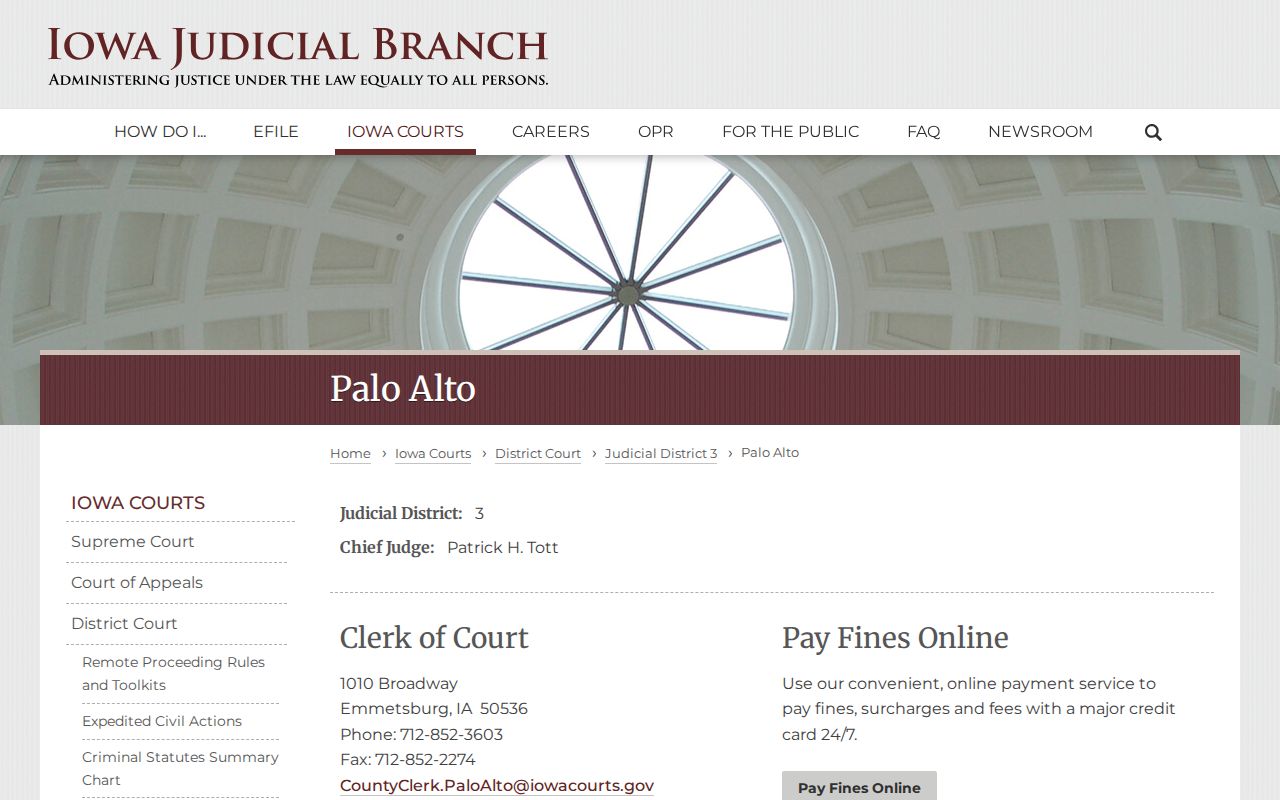
The clerk handles case files, not booking lists. For a current jail roster, ask the sheriff instead.
Note: Archive title ranges and page counts shift over time, so record the date you accessed them rather than treating them as a retention schedule.
Request an Older Palo Alto Log
Older logs have another path. Iowa's Chapter 22 lets any resident request existing records from the Palo Alto County Sheriff's Office at 2002 10th Street, Emmetsburg, Iowa 50536, or P.O. Box 126. Call 712-852-3535 first. Staff can confirm the right custodian before you send private details. Name the person, give a bounded date range, and list the exact records sought. A jail-calendar entry, booking sheet, arrest report, release record, and photograph each count as separate items.
The Iowa Courts Online portal is separate; the Iowa Public Information Board covers records requests. Its guidance covers access methods, reasonable fees, and response timing. An agency need not build a fresh weekly compilation or research a narrative for you. Ask for electronic copies and a fee estimate. Request the legal basis for any redaction, too. Palo Alto County publishes no fixed fee or turnaround, so build flexibility into your request.
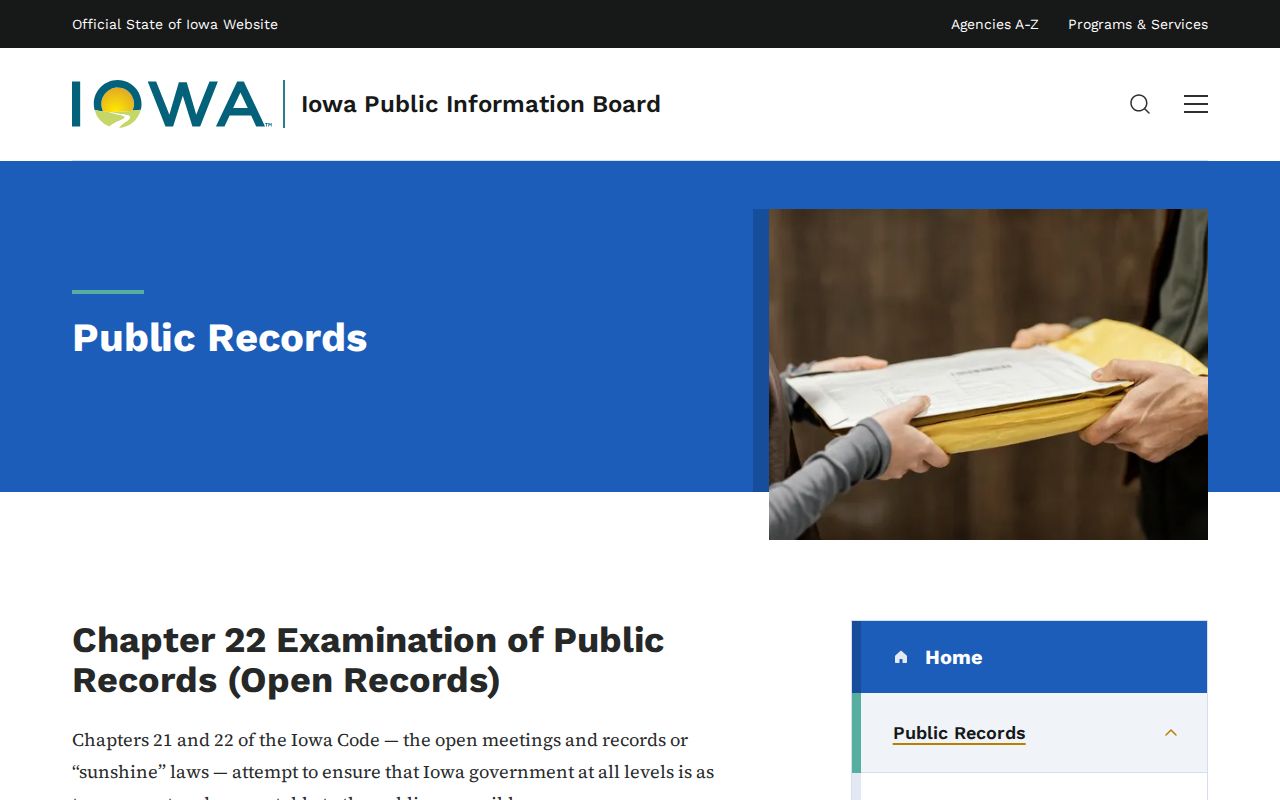
This state guidance supports access procedure but does not replace the county record custodian.
Verify Palo Alto Arrest Outcomes
A newspaper item usually stops at booking or the first court appearance. The case can move after that. It may be dismissed, amended, resolved through deferred judgment, or taken to trial. "Disposition" is simply the formal outcome the court records. A release from custody can happen several ways. It may come by bond, citation, transfer, dismissal, acquittal, or completion of a sentence.
Check a current case before relying on an old clipping. Use the clerk or a court search. Handle saved clippings with care. Never expose protected juvenile, victim, medical, or home-address details. The record that matters is the full timeline, not the loudest line in a blotter.